Posts

Analyse av nasjonal beredskap og krigstrussel i Bosnia

Image
Bosnias politiske historie og system Bosnia dukker stadig opp som samtaletema i militær sammenheng på grunn av sin nylige historie. Etter å ha vært en del av Jugoslavia siden 1920 holdt Bosnia en uavhengighetsavstemning i 1992. I respons til Bosnias uavhengighetserklæring forsøkte de bosniske serberne sin egen uavhengighetserklæring med Republika Srpska. Krigen som fulgte er beryktet for sin brutalitet, flyktningstrømmer, dødelighet og krigsforbrytelser. Dette ble den dødeligste europeiske konflikten siden 1950, nylig slått av krigen i Ukraina i offertall. Etter nesten fire år ble krigen avsluttet uten vinnere og endte med organisasjonen av en etnisk oppdelt stat etter Daytonavtalen.  Bosnia har to likeverdige landsdeler: Føderasjonen Bosnia og Hercegovina og Republika Srpska. Hele landet er ledet av det roterende presidentskapet, som alltid er en av de tre valgte presidentene. Hver av de tre anerkjente nasjonale etniske gruppene har sin egen president. Føderasjonen er laget for ...

The Armenia Azerbaijan conflict

Image
  First Nagorno Karabakh war In 1988, prior to the fall of the USSR, ethnically inspired riots started breaking out in the South Caucasus between Azeris and Armenians, especially in the region of Nagorno-Karabakh. Soviet leadership, looking elsewhere, was incapable of hindering the soaring violence. The Nagorno Karabakh Autonomous Soviet Socialist Republic had been legally part of the Azerbaijan SSR, so when the Union was broken, Nagorno Karabakh, despite being populated by a majority of Armenians, was considered to be legally a part of Azerbaijan. At the end of 1991 Nagorno Karabakh was declared the independent and Armenian led Republic of Artsakh by its people, but it did not receive any diplomatic recognition, including by Armenia. The young republic of Azerbaijan was outraged, and did not intend to allow a breakaway state from forming. Nagorno Karabakh here shown in a brighter shade of yellow than the rest of Azerbaijan (image source wikimedia) The ethnic and political conf...

The Collective Security Treaty Organization, the Russian led military bloc

Image
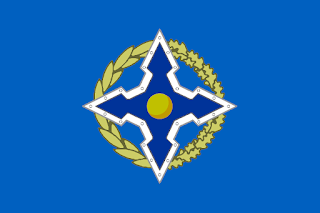
  Part one: History and identity of the Collective Security Treaty Organization Flag of the CSTO The CSTO is usually (if even discussed) described as either Russia’s attempt at making an alternative to NATO, or as a successor to the Warsaw Pact. I would argue the CSTO is much more accurately described as a successor to the Soviet Union, as part of the web of cooperation that eased the transition from empire to a patchwork of independent semi-failed states. Much like the rest of this cooperation, it serves to ensure states remain in the Russian sphere. Russia has a term for the former USSR, that being "the near abroad", implicitly stating that this region is more important for their foreign policy than any other, and that they consider themselves validated in acting in that space.  Directly after the fall of the Soviet Union there was an agreement among the majority of the successor states to form the CIS, the Confederacy of Independent States. In the early 90s the militar...